

Automatic Setup with Domain Connect (Recommended)
Cloudflare is the first DNS provider to support Lettr’s Domain Connect integration, which means you can configure all required DNS records without leaving the Lettr dashboard or touching Cloudflare’s DNS settings directly. Instead of manually creating each CNAME, TXT, and MX record, Lettr generates a signed link that tells Cloudflare exactly which records to add. You review the proposed changes on Cloudflare’s end, click Apply, and the records appear in your DNS zone within seconds. This works for all domain types — sending, tracking, and inbound. The specific records configured depend on the domain type:How to Use Automatic Setup
The process is the same regardless of which domain type you’re configuring. The example below uses a sending domain, but the steps are identical for tracking and inbound domains — only the button location and the records shown on Cloudflare’s review page will differ.1
Create the domain in Lettr
Navigate to Domains in the sidebar, then select the appropriate domain section — Sending Domains, Tracking Domains, or Inbound Domains. Click the Create button, enter your domain name (for an inbound domain, also the forwarding URL it should deliver mail to), and create the domain. This is the same step you’d take for manual setup.
2
Click Configure with Cloudflare
On the domain’s detail page, you’ll see a Configure with Cloudflare button alongside the usual DNS record table. Click it. Lettr generates a cryptographically signed URL that encodes every DNS record your domain needs, then redirects you to Cloudflare.
3
Review the proposed records
Cloudflare’s Domain Connect page displays a summary of the DNS records that will be added to your zone. Take a moment to review them — you’ll see the record types, names, and values that match what Lettr’s detail page shows. Nothing is applied until you explicitly approve.
4
Apply the changes
Click Apply to have Cloudflare add all the records to your DNS zone. This happens instantly through Cloudflare’s API. CNAME records are automatically created in DNS only mode (grey cloud), so you don’t need to worry about proxy mode causing verification failures.
5
Return to Lettr and verify
After applying, Cloudflare redirects you back to your domain’s detail page in Lettr. Click Verify DNS Records to confirm that the records are resolving. Propagation typically completes within a few seconds for Cloudflare-hosted domains, though in rare cases it may take a minute or two.
When to Use Manual Setup Instead
Automatic setup covers the most common configurations, but there are situations where manual setup is the better choice:- DNS not hosted on Cloudflare — If your domain’s nameservers point to a different provider (even if you have a Cloudflare account), Domain Connect won’t be available. Follow the manual steps below, or consult the DNS guides for your provider.
- Storage domains — Domain Connect currently supports sending, tracking, and inbound domains. Storage domain records need to be added manually.
- Authorization issues — If clicking Configure with Cloudflare results in an error or you can’t authorize the changes on Cloudflare’s side, you can always fall back to copying the records manually. The domain detail page in Lettr shows every record you need.
- Preference for manual control — Some teams prefer to review and add each record individually, especially if they maintain strict change control over their DNS zones.
Manual Sending Domain Setup
A sending domain authenticates your outgoing emails with DKIM and DMARC, ensuring they are delivered reliably and not marked as spam. This requires a CNAME record for domain verification, a TXT record for DKIM signing, and a TXT record for DMARC policy. To create a sending domain in Lettr:- Select Domains in the navigation panel
- Select Sending Domains
- Click Create Sending Domain
- Enter your desired sending subdomain (e.g.
mailing.company.com) - Click Create Domain
Configure Cloudflare DNS
Log in to the Cloudflare dashboard, click Domains in the left-hand sidebar to view a list of your domains. Select the domain you want to configure, or create a new one.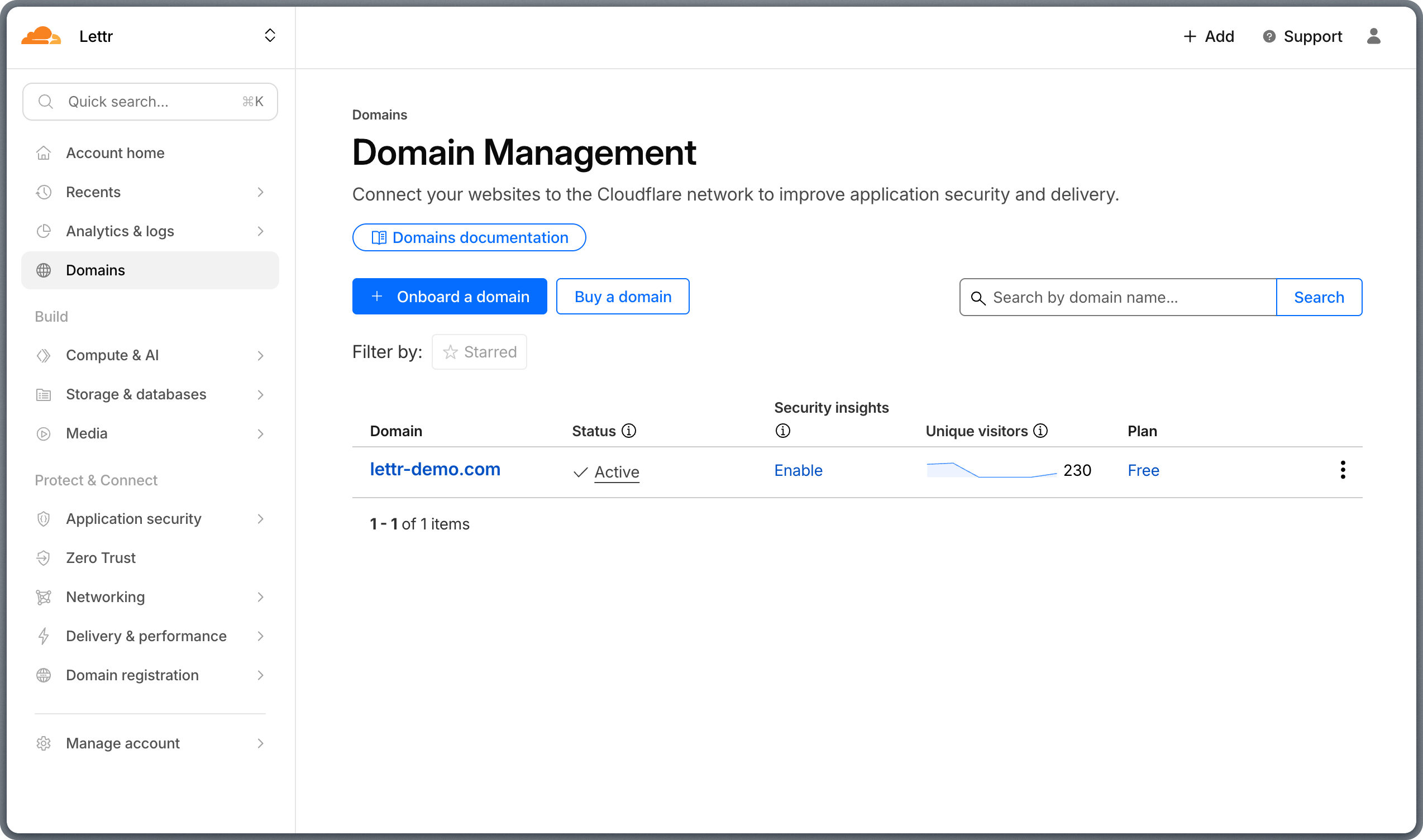
Domain registered with a different registrar?
Domain registered with a different registrar?
If you registered your domain elsewhere but want to manage DNS on Cloudflare, you must first update the nameservers
at your registrar to Cloudflare’s nameservers shown in the domain configuration. Click on your domain in the list, then follow the instructions.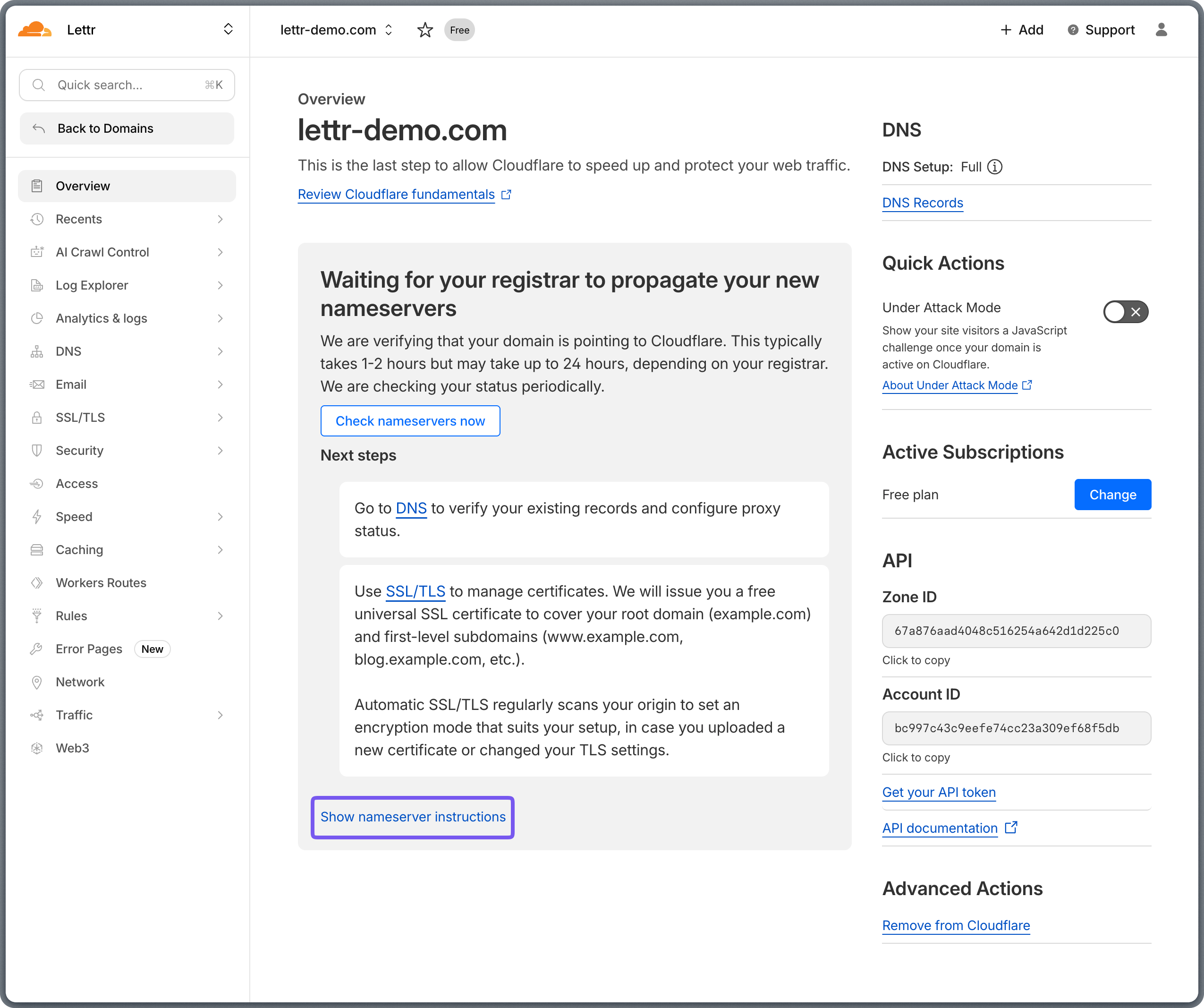
Add CNAME Record
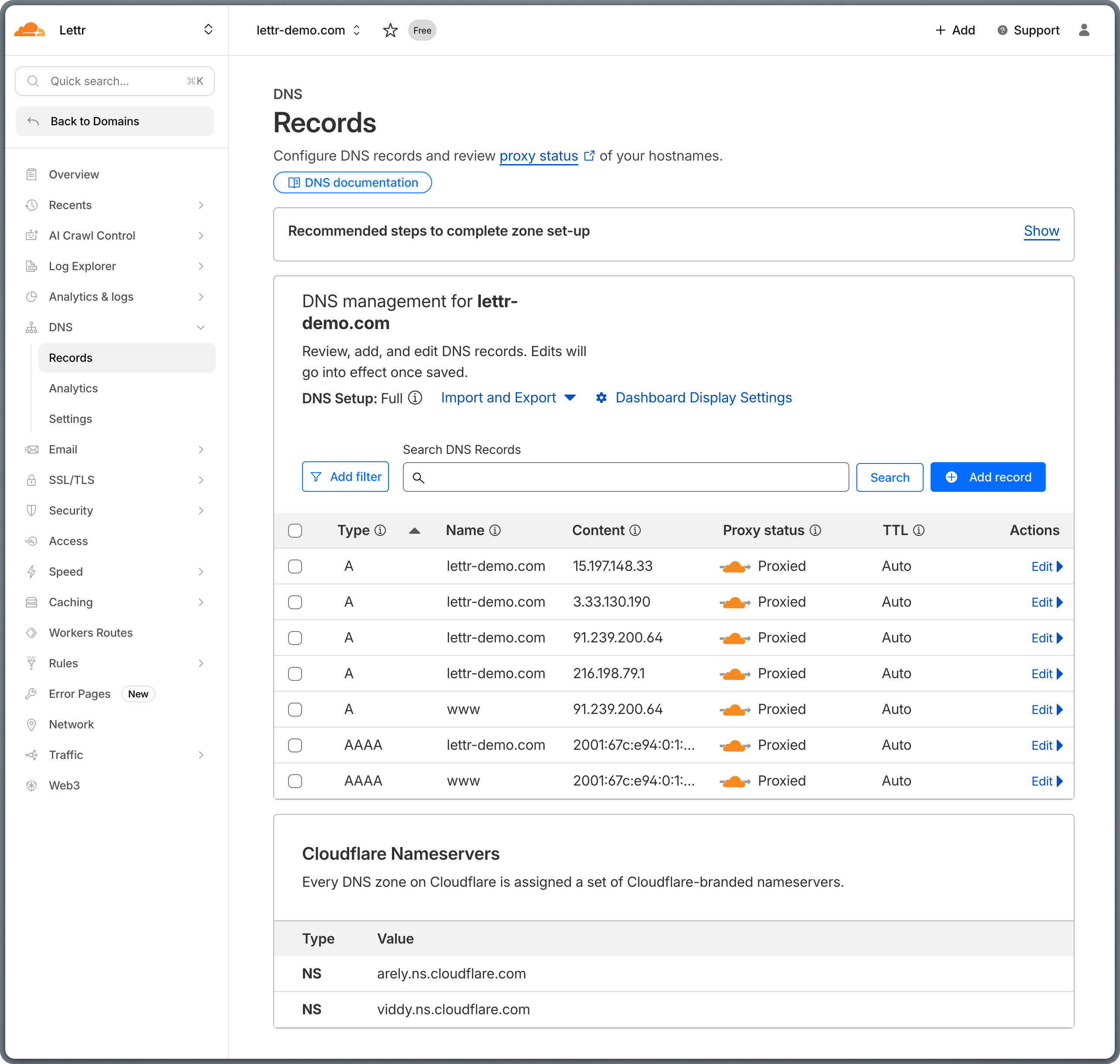
The CNAME record verifies domain ownership with Lettr’s email infrastructure. Copy the CNAME values from Lettr to Cloudflare:- Click Add record on the Cloudflare DNS page.
- Select CNAME from the Type dropdown.
- Copy the Hostname from Lettr and paste it into the Name field in Cloudflare.
- Copy the Value from Lettr and paste it into the Target field in Cloudflare.
- Set Proxy status to DNS only (grey cloud). Click the orange cloud icon to toggle it off.
- Leave TTL set to Auto.
- Click Save.
Omit your domain suffix from the Hostname when pasting into Cloudflare. For example, instead of
mailing.lettr-demo.com, paste only mailing.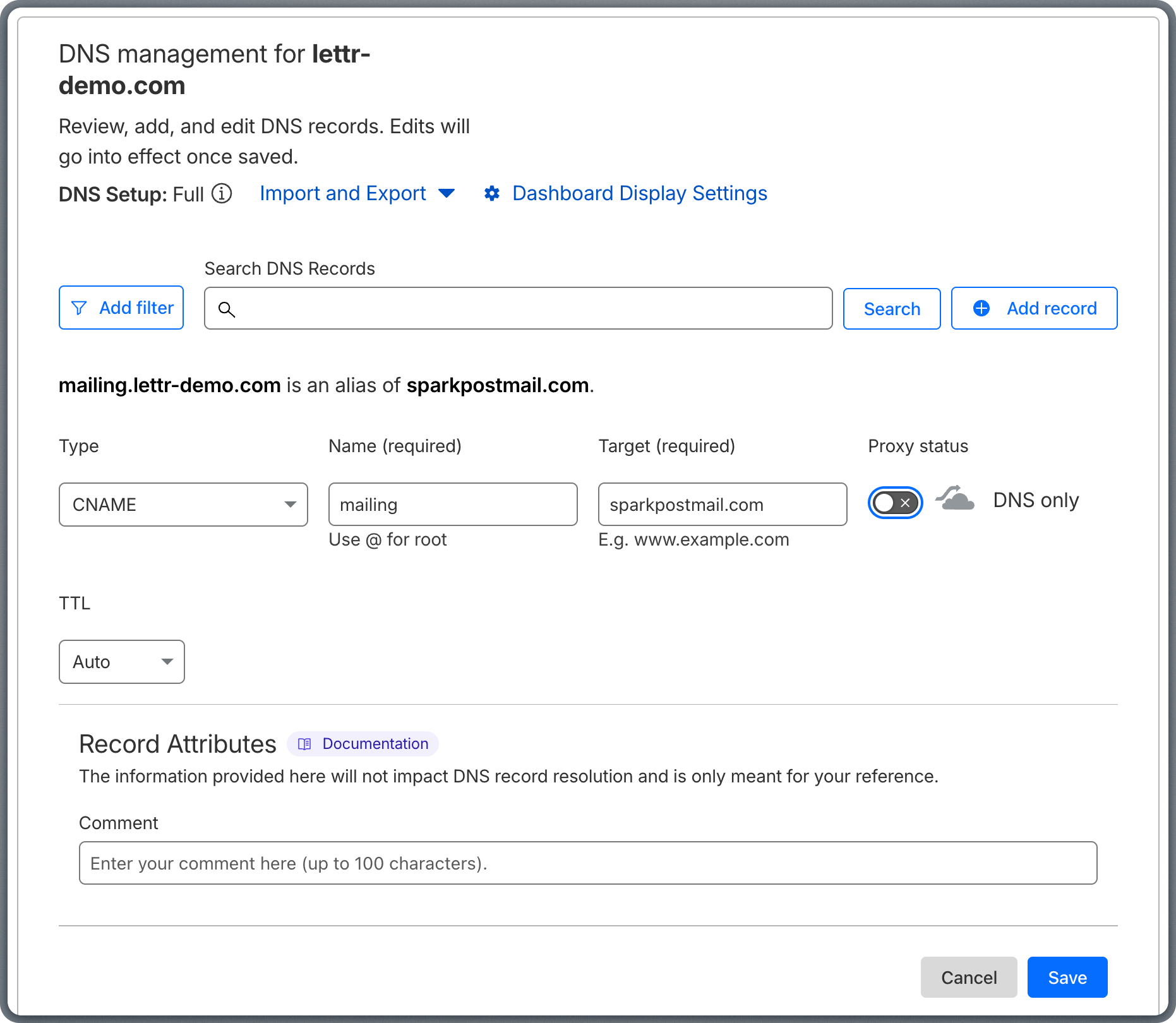
Add TXT Record (DKIM)
The DKIM record adds a cryptographic signature to your outgoing emails, allowing recipients to verify they were sent by an authorized sender. Copy the TXT values from Lettr to Cloudflare:- Click Add record on the Cloudflare DNS page.
- Select TXT from the Type dropdown.
- Copy the Hostname from Lettr and paste it into the Name field in Cloudflare.
- Copy the Value from Lettr and paste it into the Content field in Cloudflare.
- Leave TTL set to Auto.
- Click Save.
Omit your domain suffix from the Hostname when pasting into Cloudflare. For example, instead of
scph0126._domainkey.mailing.lettr-demo.com, paste only scph0126._domainkey.mailing.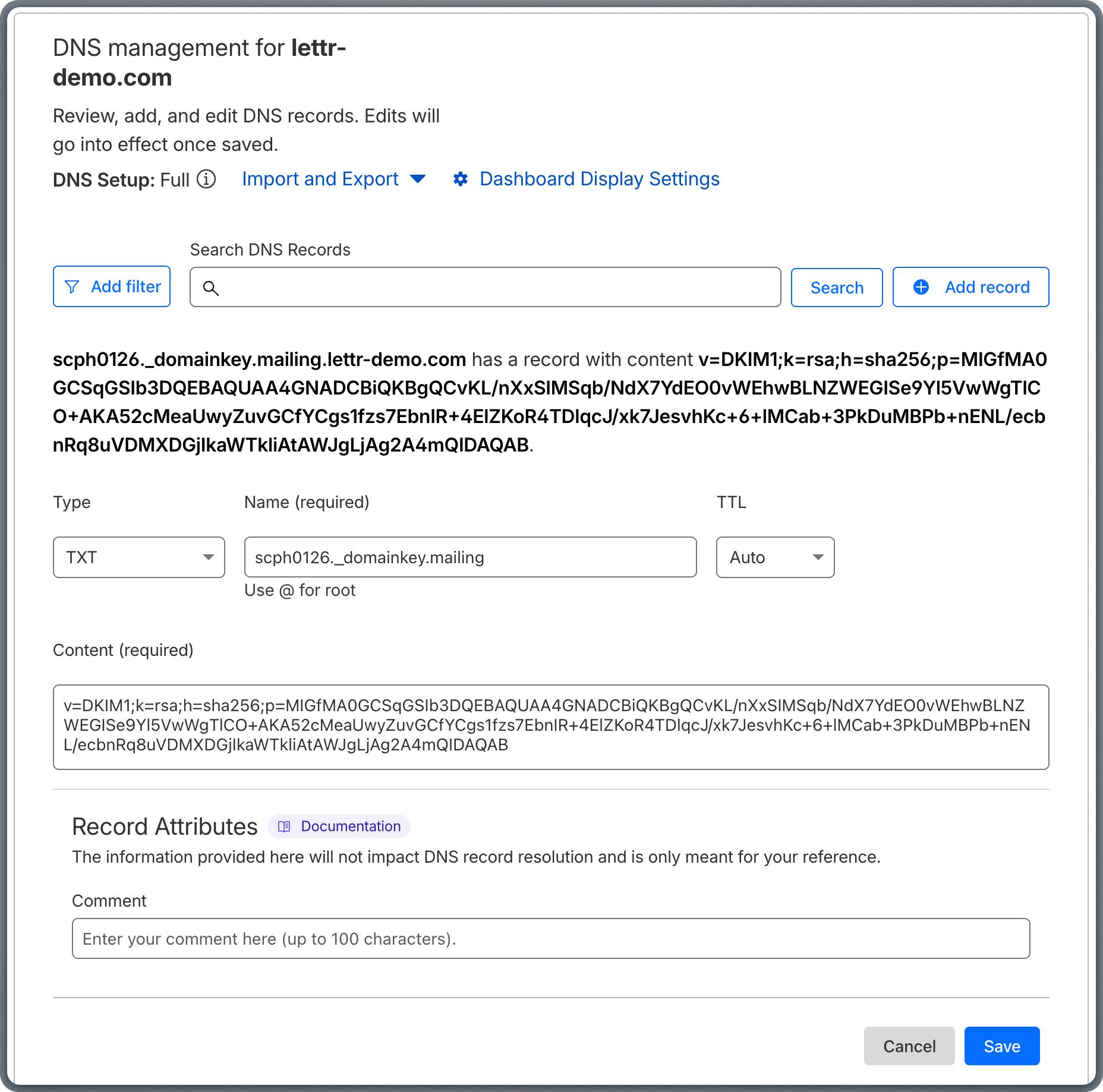
Add TXT Record (DMARC)
The DMARC record tells receiving mail servers how to handle emails that fail authentication checks, protecting your domain from spoofing. Copy the TXT values from Lettr to Cloudflare:- Click Add record on the Cloudflare DNS page.
- Select TXT from the Type dropdown.
- Copy the Hostname from Lettr and paste it into the Name field in Cloudflare.
- Copy the Value from Lettr and paste it into the Content field in Cloudflare.
- Leave TTL set to Auto.
- Click Save.
Omit your domain suffix from the Hostname when pasting into Cloudflare. For example, instead of
_dmarc.mailing.lettr-demo.com, paste only _dmarc.mailing.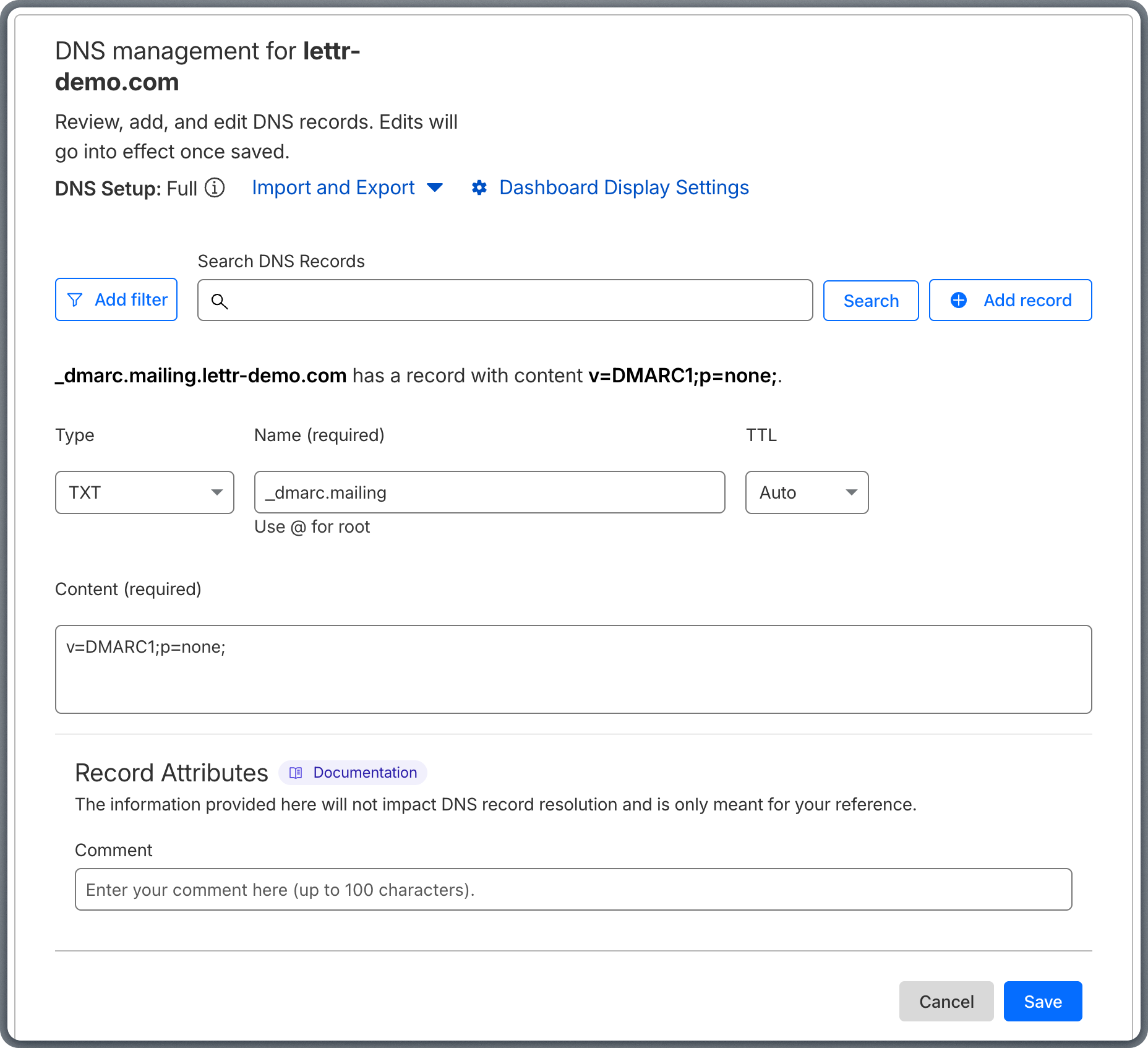
Verify Your Sending Domain
After adding all three DNS records, go back to Lettr and click Verify DNS Records. DNS propagation can take up to 24–48 hours, though it typically completes within a few minutes.Manual Inbound Domain Setup
An inbound domain allows Lettr to receive emails on your behalf. This requires three MX records that direct incoming mail to Lettr’s mail servers.Add Inbound Domain to Lettr
To create an Inbound domain in Lettr:- Select Domains in the navigation panel
- Select Inbound Domains
- Click Create Inbound Domain (New Inbound Domain if you already have one)
- Enter your desired inbound subdomain (e.g.
inbound.company.com) - Enter the Forwarding URL where Lettr should deliver mail sent to this domain (e.g.
https://yourapp.com/webhooks/inbound) - Optionally enter an Auth token. Lettr sends it in the
X-MessageSystems-Webhook-Tokenheader so your endpoint can verify each request. - Click Create Inbound Domain
The forwarding URL is required and is tested before the domain is created. Your endpoint must answer the test
POST request with a 2xx status. If it doesn’t, the domain is not created and Lettr shows the status your endpoint returned. See Inbound Email Setup if a firewall blocks the test.Add MX Records
MX records tell other mail servers where to deliver emails addressed to your domain. Copy the MX values from Lettr to Cloudflare:- Click Add record on the Cloudflare DNS page.
- Select MX from the Type dropdown.
- Copy the Hostname from Lettr and paste it into the Name field in Cloudflare.
- Copy the first Required MX Record value (without the priority number) from Lettr and paste it into the Mail server field in Cloudflare.
- Copy the Priority number (e.g.
10) from Lettr and paste it into the Priority field in Cloudflare. - Leave TTL set to Auto.
- Click Save.
- Repeat this process for the second (rx2.sparkpostmail.com) and third (rx3.sparkpostmail.com) MX records.
Omit your domain suffix from the Hostname when pasting into Cloudflare. For example, instead of
inbound.lettr-demo.com, paste only inbound.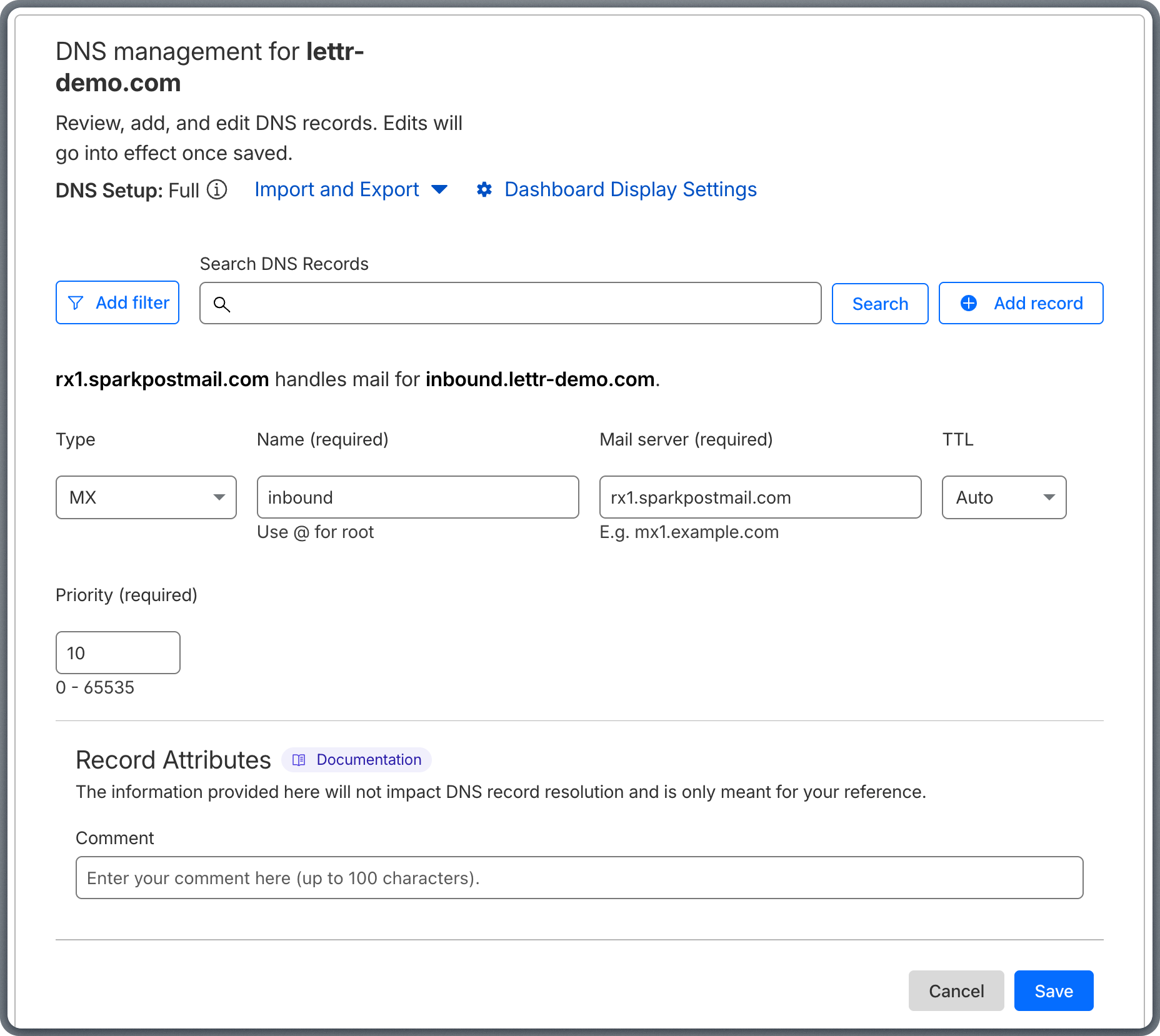
Verify Your Inbound Domain
After adding all three MX records, go back to Lettr and click Verify MX Records. DNS propagation can take up to 24–48 hours, though it typically completes within a few minutes. Once the MX records verify and a forwarding URL is set, the domain shows Receiving mail in the Inbound Domains list. If the domain has no MX records, the failed check shows where mail sent to it is actually going instead.Manual Tracking Domain Setup
A tracking domain allows Lettr to track email opens and link clicks using your own custom domain instead of the default Lettr tracking domain. This requires two CNAME records: one for the SSL certificate and one for routing tracking traffic to Lettr’s infrastructure.Add Tracking Domain to Lettr
To create a Tracking domain in Lettr:- Select Domains in the navigation panel
- Select Tracking Domains
- Click Create Tracking Domain
- Enter your desired tracking subdomain (e.g.
tracking.company.com) - Click Create Domain
Add SSL Certificate CNAME Record
The SSL Certificate CNAME record provisions an SSL certificate for your custom tracking domain, enabling secure HTTPS connections for tracked links. Add the record in Cloudflare:- Click Add record on the Cloudflare DNS page.
- Select CNAME from the Type dropdown.
- Copy the Hostname from Lettr and paste it into the Name field in Cloudflare.
- Copy the Value from Lettr and paste it into the Target field in Cloudflare.
- Set Proxy status to DNS only (grey cloud).
- Leave TTL set to Auto.
- Click Save.
Omit your domain suffix from the Hostname when pasting into Cloudflare. For example, instead of
track.lettr-demo.com, paste only track.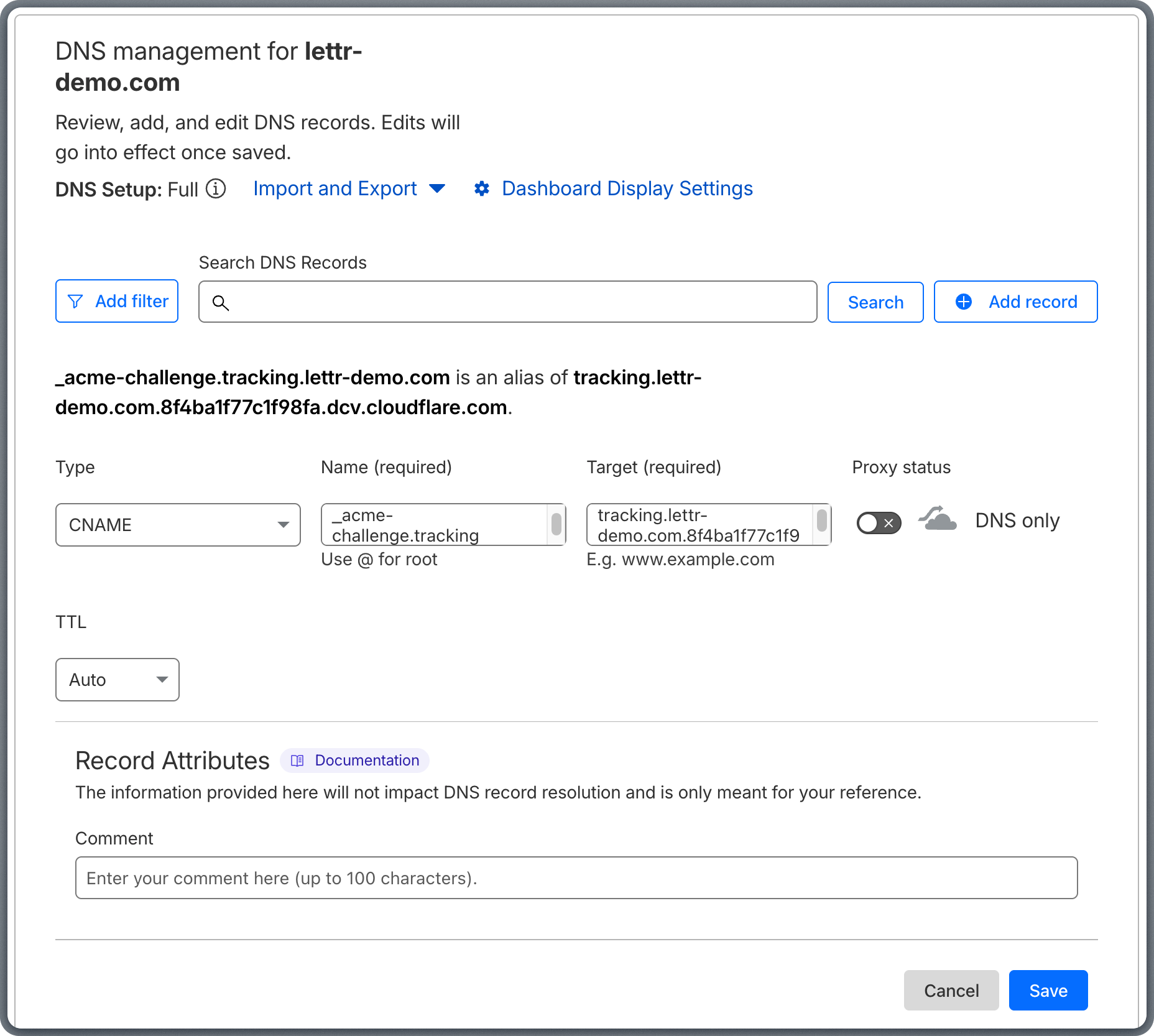
Add Traffic CNAME Record
The Traffic CNAME record routes click and open tracking requests from your custom domain to Lettr’s tracking servers. Add the record in Cloudflare:- Click Add record on the Cloudflare DNS page.
- Select CNAME from the Type dropdown.
- Copy the Hostname from Lettr and paste it into the Name field in Cloudflare.
- Copy the Value from Lettr and paste it into the Target field in Cloudflare.
- Set Proxy status to DNS only (grey cloud).
- Leave TTL set to Auto.
- Click Save.
Omit your domain suffix from the Hostname when pasting into Cloudflare. For example, instead of
track.lettr-demo.com, paste only track.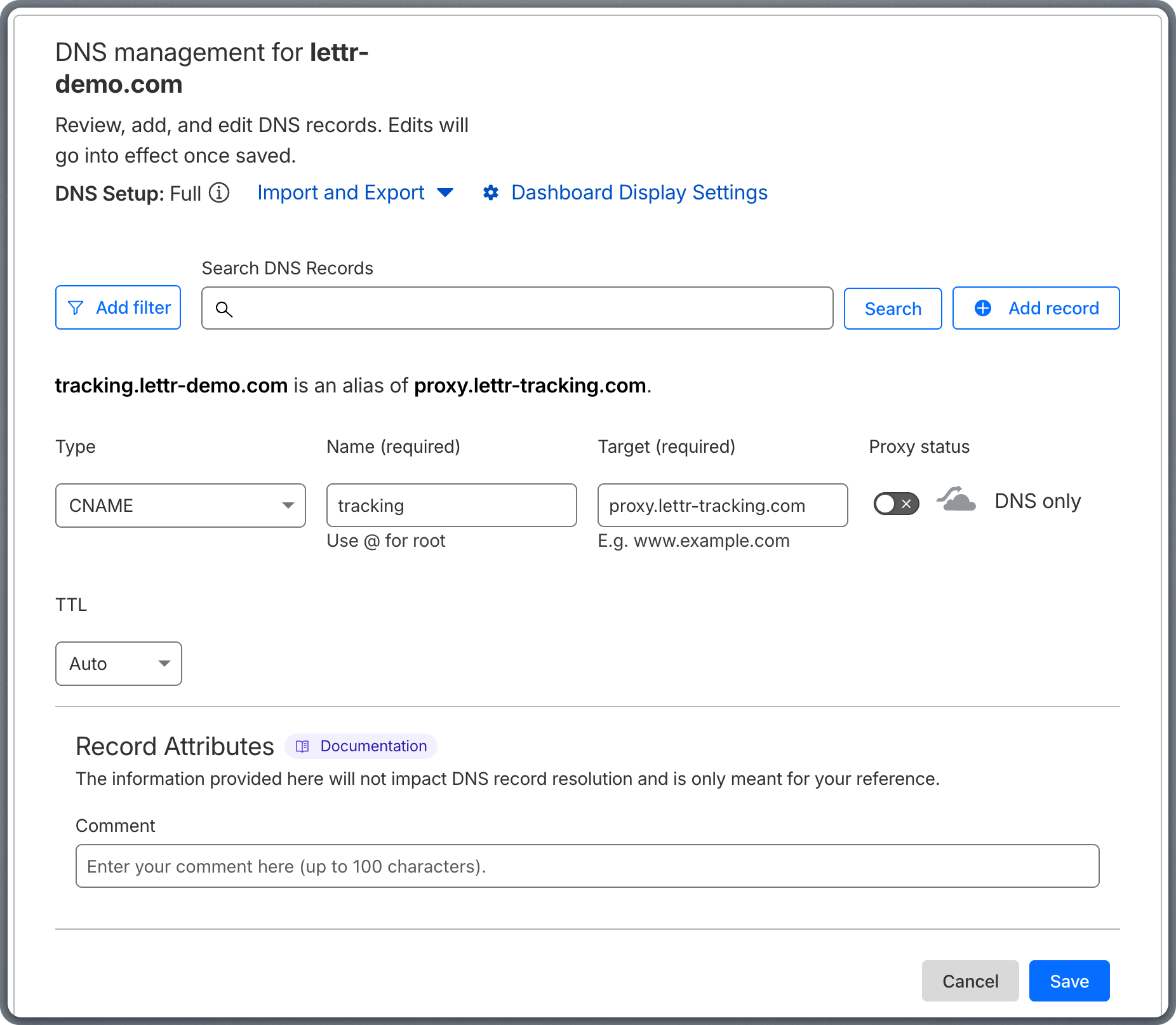
Verify Your Tracking Domain
After adding both CNAME records, go back to Lettr and click Verify DNS Records.Manual Storage Domain Setup
A storage domain lets you serve email assets (images, attachments) from your own custom domain instead of the default Lettr storage URL. This requires two TXT records for certificate validation and ownership verification, and a CNAME record for routing asset requests to Lettr’s storage infrastructure.Add Storage Domain to Lettr
To create a Storage domain in Lettr:- Select Domains in the navigation panel
- Select Storage Domains
- Click Create Storage Domain
- Enter your desired storage subdomain (e.g.
assets.company.com) - Click Create Domain
Add TXT Record (Certificate Validation)
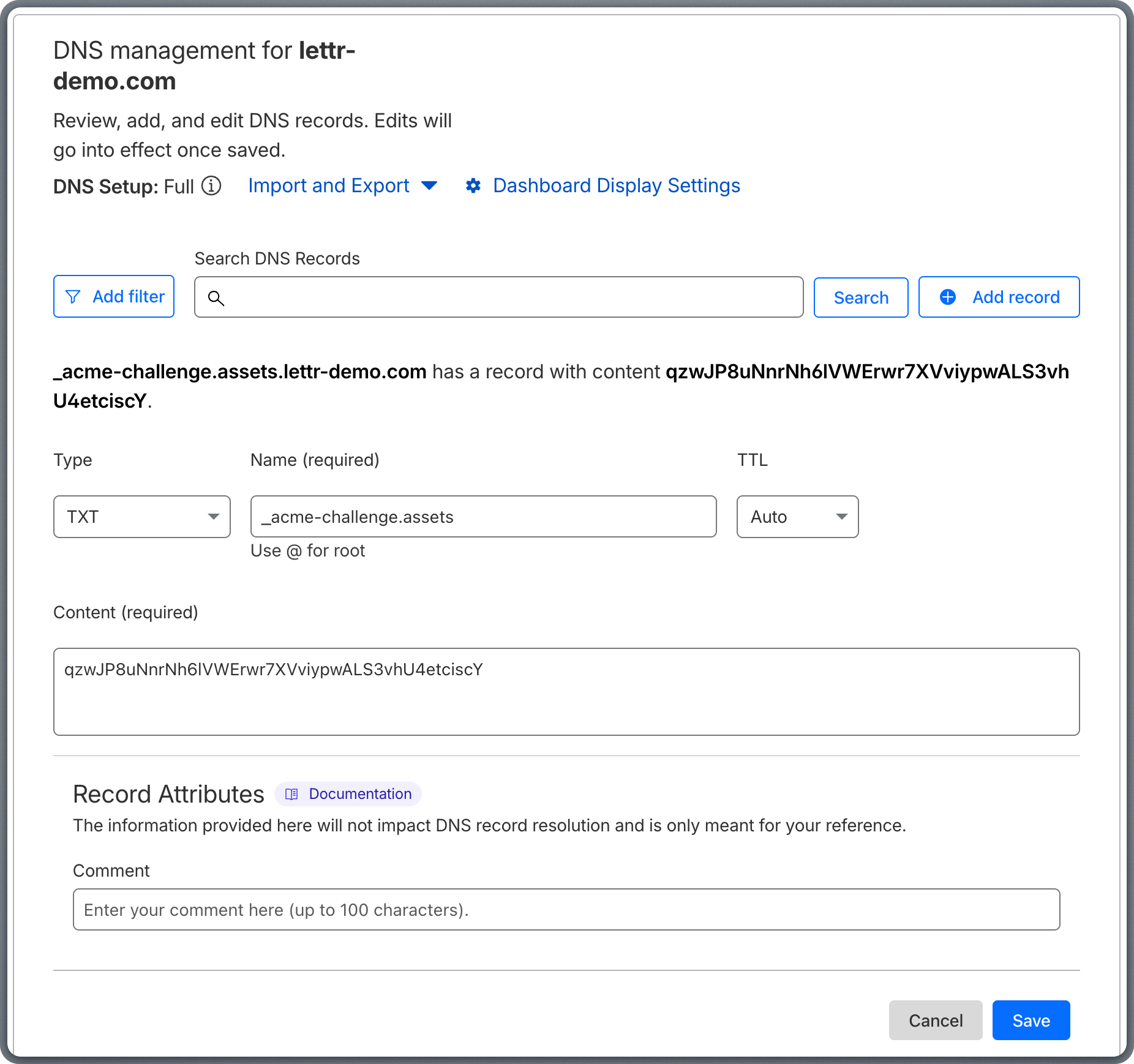
The Certificate Validation TXT record provisions an SSL certificate for your custom storage domain, enabling secure HTTPS delivery of email assets. Add the record in Cloudflare:- Click Add record on the Cloudflare DNS page.
- Select TXT from the Type dropdown.
- Copy the Hostname from Lettr and paste it into the Name field in Cloudflare.
- Copy the Value from Lettr and paste it into the Content field in Cloudflare.
- Leave TTL set to Auto.
- Click Save.
Omit your domain suffix from the Hostname when pasting into Cloudflare, just as with the CNAME record above.
Add TXT Record (Hostname Pre-validation)
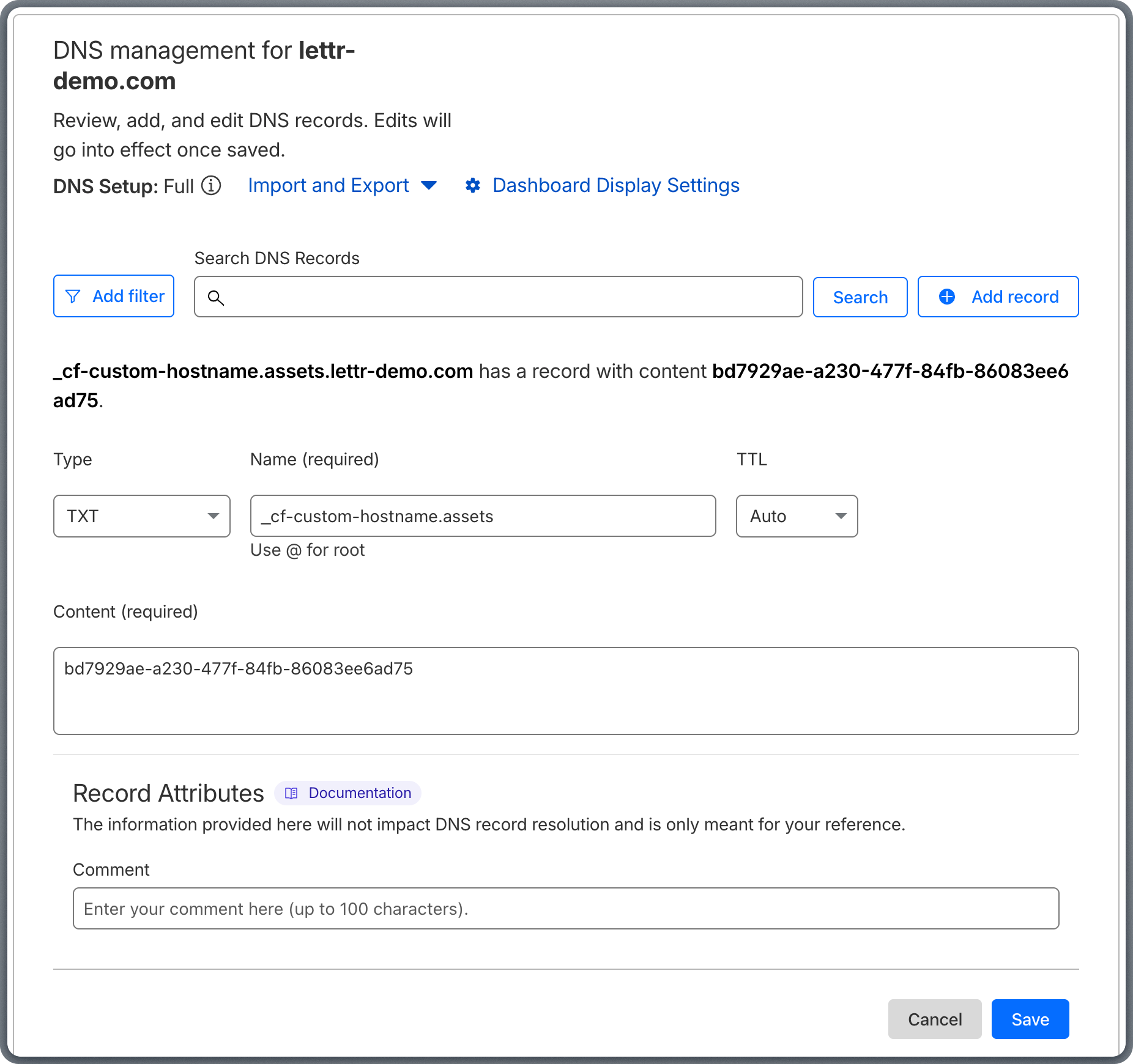
The Hostname Pre-validation TXT record verifies ownership of the storage domain before Lettr provisions a custom hostname for it. Add the record in Cloudflare:- Click Add record on the Cloudflare DNS page.
- Select TXT from the Type dropdown.
- Copy the Hostname from Lettr and paste it into the Name field in Cloudflare.
- Copy the Value from Lettr and paste it into the Content field in Cloudflare.
- Leave TTL set to Auto.
- Click Save.
Omit your domain suffix from the Hostname when pasting into Cloudflare, just as with the CNAME record above.
Add CNAME Record (Domain Routing)
The Domain Routing CNAME record routes asset requests from your custom domain to Lettr’s storage infrastructure. Add the record in Cloudflare:- Click Add record on the Cloudflare DNS page.
- Select CNAME from the Type dropdown.
- Copy the Hostname from Lettr and paste it into the Name field in Cloudflare.
- Copy the Value from Lettr and paste it into the Target field in Cloudflare.
- Set Proxy status to DNS only (grey cloud).
- Leave TTL set to Auto.
- Click Save.
Omit your domain suffix from the Hostname when pasting into Cloudflare. For example, instead of
assets.lettr-demo.com, paste only assets.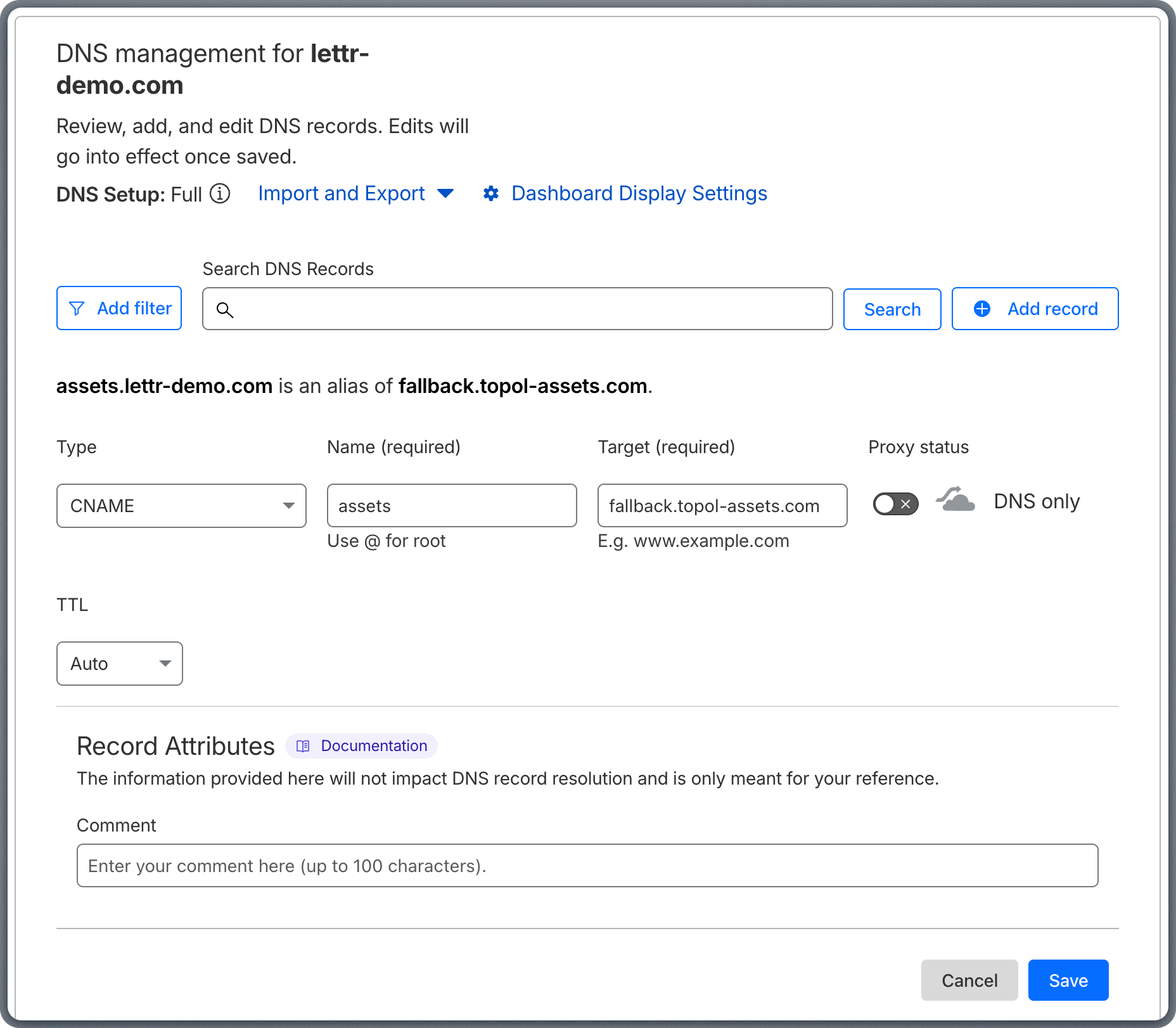
Verify Your Storage Domain
After adding all three records, go back to Lettr and click Verify DNS Records.Troubleshooting
Proxy Mode Enabled (Orange Cloud)
Proxy Mode Enabled (Orange Cloud)
This is the most common issue when using Cloudflare with Lettr. Cloudflare’s proxy mode (orange cloud icon) intercepts and rewrites DNS responses, which causes CNAME verification to fail because Lettr cannot see the original CNAME target.How to fix:
- Go to your domain in the Cloudflare dashboard.
- Open the DNS tab.
- Find each CNAME record you added for Lettr.
- Click the orange cloud icon next to the record to toggle it to DNS only (grey cloud).
- Wait a few minutes for the change to propagate, then re-verify in Lettr.
Domain Suffix Not Omitted
Domain Suffix Not Omitted
Cloudflare automatically appends your domain to the record name. If you paste the full hostname (e.g.
mailing.lettr-demo.com), the resulting record will be mailing.lettr-demo.com.lettr-demo.com, which will fail verification.Always paste only the subdomain portion (e.g. mailing, scph0126._domainkey.mailing, _dmarc.mailing).Records Not Propagating
Records Not Propagating
If verification fails after adding records, check the following:
- Wait at least 30 minutes before your first verification attempt. Most records propagate within 1–2 hours.
- Confirm proxy mode is off for all CNAME records (see above).
- Confirm the records exist using command-line tools:
- Use a web tool like dnschecker.org to verify propagation across multiple DNS servers worldwide.
Wrong Record Type
Wrong Record Type
A common mistake is selecting the wrong type in Cloudflare’s dropdown:
DKIM Value Truncated
DKIM Value Truncated
The DKIM TXT value is a long string. Cloudflare handles long TXT values well, but copying errors can occasionally cut off the string. After saving the record, click Edit on the record to confirm the full value was stored. If it appears truncated, try pasting the value again.
Nameservers Not Pointing to Cloudflare
Nameservers Not Pointing to Cloudflare
If your records are saved in Cloudflare but not resolving, confirm that your domain registrar is pointing to Cloudflare’s nameservers. You can check this with:The output should include the two Cloudflare nameservers assigned to your domain (e.g.
anna.ns.cloudflare.com, bob.ns.cloudflare.com). These are displayed on the domain overview page in the Cloudflare dashboard. If the output shows a different provider’s nameservers, update them at your domain registrar.CNAME Flattening at Root
CNAME Flattening at Root
If you are adding a CNAME record at the root of your domain (e.g.
company.com instead of mailing.company.com), Cloudflare will automatically apply CNAME flattening. This resolves the CNAME to an A record, which can cause verification to fail. Use a subdomain for your sending domain to avoid this issue.When to Contact Support
When to Contact Support
If your DNS records are correctly configured (confirmed with
dig or dnschecker.org), proxy mode is disabled for all CNAME records, and verification still fails after 48 hours, contact Lettr support at support@lettr.com or through the in-app chat. Include your domain name and the output of the dig commands above.Related Topics
Sending Domains
Learn about sending domain setup, SPF, DKIM, and DMARC.
Inbound Domains
Configure MX records to receive emails with Lettr.
Tracking Domains
Set up a custom tracking domain for click and open tracking.
Storage Domains
Serve email assets from your own custom domain.
Domain Connect
How automatic DNS setup works under the hood.
Domains Overview
Understand domain types and how they work in Lettr.
Domain Verification Failures
Troubleshoot common DNS configuration and propagation issues.